a bilingual (Vietnamese-English) literary, ethnic and pop culture E-magazine edited by Wendi Nicole Duong (Nhu-Nguyen). Tập san song ngữ (Việt Anh) với nội dung văn học sáng tạo, văn hóa nguồn cội, và văn hóa hiện đại do Dương Như Nguyện (cùng thân hữu) chủ trương và chủ bút.
May 2015 edition is dedicated to Motherhood and the mother-daughter relationship in celebration of Mother's Day.
Số tháng Năm 2015 dành cho mẹ.
VH Tiếng Nói Văn Học Việt Houston VH
VVH Tiếng Nói Văn-Học Việt-Houston (Viet Voice From Houston). Xin gửi bài vở về địa chỉ wendynicolennduong@post.harvard.edu. Contributing articles and commentaries should be submitted to wendynicolennduong@post.harvard.edu.
COPYRIGHT NOTICE AND DISCLAIMER
Về vấn đề bản quyền (copyright) cho tác giả Việt Nam của các bài viết được đăng tải ở đây: Chúng tôi nhận được những bài viết này từ độc giả hoặc từ các môi trường truyền thông của các nhóm người Việt, vì tác phẩm đã được phổ biến ở một môi trường công cộng nào đó. Chúng tôi mạn phép đăng tải theo lời giới thiệu của độc giả, dưới thẩm quyền "fair use exception" của luật trước tác bản quyền, vì làm việc cho mục đích giáo dục quần chúng, không vụ lợi. Nếu độc giả nào biết tác giả, xin cho chúng tôi biết để gửi lời chính thức xin phép, hoặc nếu tác giả không bằng lòng, xin cho chúng tôi biết ngay để chúng tôi lấy bài xuống theo ý của tác giả.
disclaimer re content
Quan điểm của tác giả hay độc giả trình bày ở đây không phải là quan điểm của người hay nhóm chủ trương VVFH, và vì thế chúng tôi không chịu trách nhiệm về những quan điểm hay dữ kiện đưa ra bởi tác giả hay độc giả. The views and supporting facts expressed by the authors or commenters published here are not necessarily those expressed or endorsed by VVFH or its editors. Accordingly, VVFH disclaims liability with respect to such content.
MỤC ĐÍCH:
Lời nhắn với học trò Việt Nam của giáo sư WENDI NICOLE Dương, cựu học giả FULBRIGHT Hoa Kỳ và cựu giáo sư luật đại học Denver:
Cô thành lập tập san này là đề cố gắng giữ lại những cái đẹp trong văn hóa cội nguồn của Việt Nam, đã giúp chúng ta đứng vững trên hai ngàn năm, dựa trên những giá trị đặc thù của người Việt nhưng đồng thời cũng là giá trị tổng quát của nhân loại. Hy vọng TIENG NOI VAN HOC VIET-HOUSTON, gọi tắt là VH, hay VVFH (Viet Voice from Houston) sẽ đến với người Việt trên toàn thế giới, qua độc giả thích văn chương văn học trong cả hai ngôn ngữ Việt-Anh, từ bàn tay và ánh mắt của một số it học trò Việt đang sinh sống ở Mỹ hoặc ở Việt Nam, của chính cô, cũng như của thế hệ đi trước biểu tượng là cha mẹ cô, những giáo sư ngôn ngữ.
Wendi Nicole Duong (Nhu-Nguyen) tháng tư April 2015
TRIO OF WATER LILIES
TRIO OF WATER LILIES enamel, markers, pen and pencil on paper. artwork by Wendi Nicole Duong copyright 2013: in all three regions of Vietnam, one can always find Hoa Sung, water lilies!
How would one paint darkness? Especially when one has only five minutes to spare? Here is another of my five-minute creation.
Does darkness mean all black? Painters know that there are hundreds of black shades and hundreds of white shades...I think darkness has colors. So, here is how I painted darkness, from the perspective of a woman sitting in the dark, or immerging herself in it. So her face is the color of a sombre shadow. The Vietnamese verses describe her mood (translation: "I am my own darkness, my sombre green...Loyalty or betrayal? All from the same spleen...").
The joy of impromptu raw art is the envisioning of a backdrop. I created a cheerful backdrop for these verses of sombreness, with lots of pink.
1) Woman and darkness UND C 2010, 2016 enamel and markers on grained paper
2) verses of sombreness in Vietnamese UND C2016 markers enamel and pastel on thin paper
3) variations with digital inversion and color infusion UND C 2020
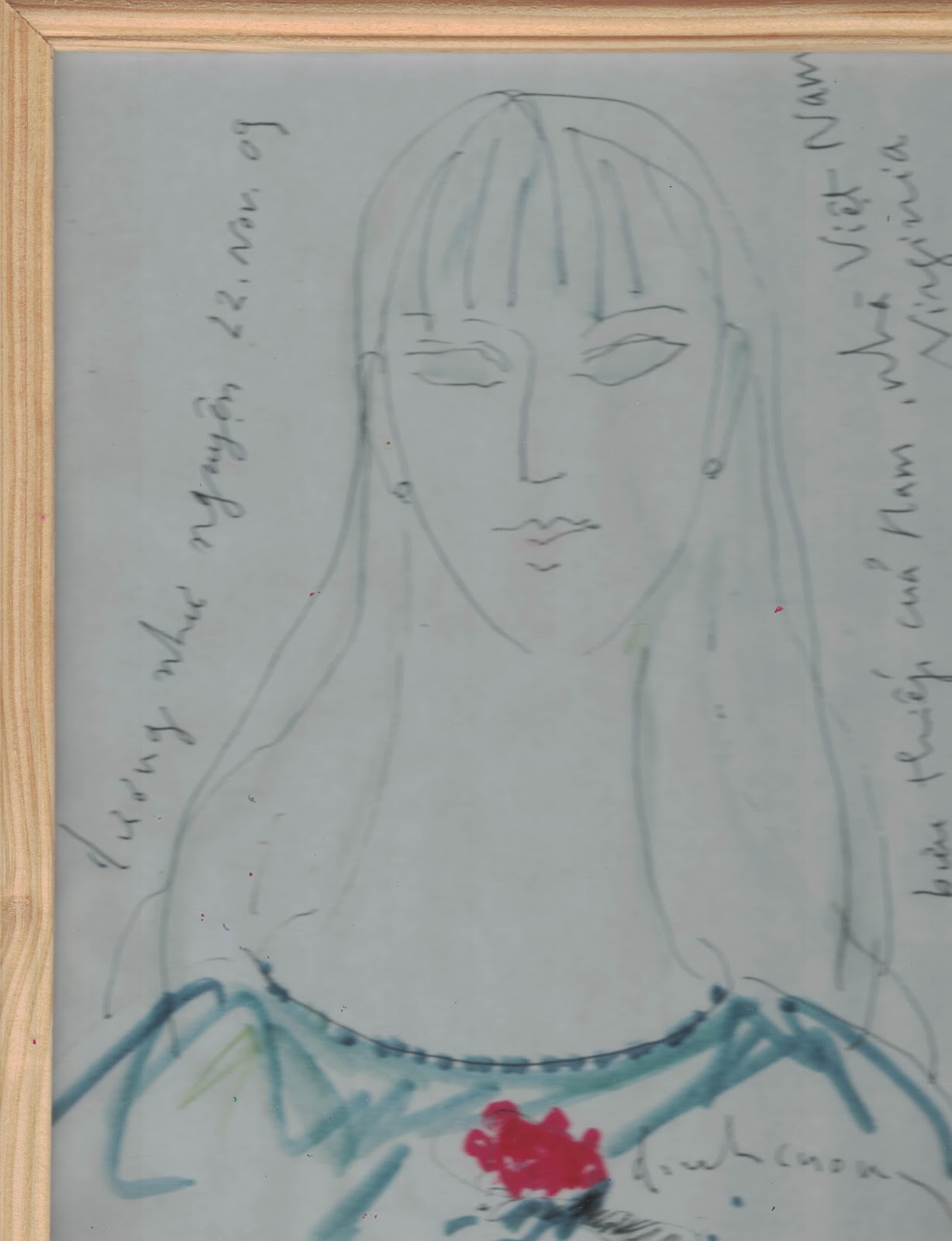
DC was my father's friend from their time in Hue. My father was among the first ones to purchase his paintings in America, with half of my father's monthly check on a teacher's salary. At two of my occasional community's speeches in Virginia, he sketched me from sitting in the audience and gave the sketch to me at the end of the program. Uncle DC had an air of ardent detachment about him, as though he were walking in a dream, indeed the aging Little Prince of Vietnam. A few years later, when I picked up painting again, two of my L'art Brut works were developed based on Dinh Cuong's motifs. I regret not showing them to him. He never knew that I painted. The news of his death was a surprise just as his sketches of me were a surprise. The sketches were joy. The news was sadness. To this day, my father, who has dementia, has not known that he has lost another one of his friends from the Hue circle of art in the 1960s. My brother became the proud owner of Dinh Cuong's painting of the Viet Lady in the pink dress and her church, which used to be in the small hallway of my father's home. Đinh Cường: "Ra đi mới biết lòng vô hạn. Mỗi bức tranh là mỗi [chuyến] [ra] đi."
THE INFINITE NATURE OF DREAM IN ART
Có đi mới biết tranh là ảo
Mỗi bức tranh là một giấc mơ
Chân đã chạm thuyền, sơn chấm vải
Khoảnh khắc thiên thu, vẫn đợi chờ...
DNN 2017
ĐINH CƯỜNG: TRĂNG SAO VÀ ĐÁ TẢNG
"Art is a distinctive but rare-to-find form of life. I have painted in all different situations, locations without realizing why. There are times when I almost felt desperate and there are also times when I had a sense of being redeemed. And I continue to paint and to meditate." DC « tôi đã dần dần tước bỏ hết ý niệm về sự vật, hay nói theo danh từ triết học kinh điển, loại bỏ mô thể, forme, của sự vật để chỉ còn giữ lại chất liệu, matière, thuần túy của sơn dầu ». DC
FOR VIET READERS: ĐINH CƯỜNG'S EARLY ABSTRACT -- TRỪU TƯỢNG CUẢ ĐINH CƯỜNG QUA MẮT NHÌN CUẢ GS DƯƠNG ĐỨC NHỰ -- WHEN THEY WERE ALL YOUNG Sự bứt phá cuả tuổi trẻ Đinh Cường:
“Trong vũ trụ, súc vật, đồ đạc, người ngợm lổn ngổn, những võ công thức cứng ngắc, rỗng tuếch, đập bửa ra toàn chất liệu chết, ù lì, đặc sệt; những cái đầu gỗ lọc cọc múa nhảy trên đường, những trường thành góc cạnh lì lì chắn lối; những xe cộ, bàn ghế, cây khô tĩnh vật đắp ụ ngõ xóm; đất rác từng đống sát mũi cửa nhà, bịt kín công lộ. Những cái cứng ngắc, lổn ngổn, trì độn ấy làm nghệ sĩ đi một bước là đụng, là đá, là vấp chạm đủ mọi chướng vật. Ấy là cái thế giới hình thể hiện thực bủa kín nghệ sĩ, muốn bò-sát-hóa thân phận nghệ sĩ. Nó bảo: mày làm con lừa kéo gỗ đi. Nó hô: cúi đầu xuống, uốn đuôi lên. Thế giới hình thể hiện thực vong thân nghệ sĩ bằng đủ kiểu phỉnh phờ. Nó chắp cánh gỗ cho nghệ sĩ bay vào thế giới lãng mạn, trăng sao mây nước. Nó gạt nghệ sĩ vào vũ trụ ấn tượng mù, lung linh bàng bạc. Rồi, rất biện chứng, nó đá đít những tâm hồn nghệ sĩ đích thực…
Tôi không tự hỏi Đinh Cường đã đi vào trừu tượng thế nào ? Cái đó chẳng quan hệ gì đến người xem tranh, dĩ nhiên. Sự hiện hữu của trừu tượng Đinh Cường, tôi sẵn nhìn nó trong hình ảnh một bứt phá…”
QUA MẮT NHÌN CUẢ ĐẶNG TIẾN, NGUYÊN TÁC TIẾNG PHÁP:
REPRINT UNDER THE FAIR USE EXCEPTION TO COPYRIGHT:
Họa sĩ Đinh Cường từ tiểu bang Virginia, Hoa Kỳ, sang Paris bày tranh tại phòng triển lãm Annam Héritage, từ 28.10 đến 6.11.2010.
Đinh Cường mài miệt, mãi miết vẽ đều tay từ nửa thế kỷ nay ; đây không biết là lần triển lãm thứ mấy từ ngày anh mới ra trường 1963 ; và từ khi sang định cư tại Mỹ, 1989. Lần bày tranh gần đây nhất là tại Huế, mùa hè 2009. Đinh Cường sống trọn đời, tận tụy, cho nghiệp hội họa – không nhất thiết là sống nhờ vào nghề hội họa. Anh triển lãm nhiều, không nhất thiết để bán tranh mà để gặp gỡ, làm quen. Vẽ tranh là tìm đến với cuộc đời ; và bày tranh là đi trọn dặm trường hạnh ngộ. Nói khác đi, làm khác đi, là chưa hết lòng với chính mình và chưa tận tình với nghệ thuật.
Đinh Cường có câu thơ hay : Ra đi mới biết lòng vô hạn. Mỗi bức tranh là mỗi ra đi.
Có lần có kẻ yêu cầu tôi nói về tranh Đinh Cường trong vài ba chữ, tôi đã trả lời bằng một hình ảnh : tranh Đinh Cường là mạch nước ngầm tuôn trào lên khung vải. Đối thoại hồn nhiên thôi, nhưng ngày qua tháng lại có vẻ hợp lý, khi nhìn lại từ nguồn sáng tạo đến họa phẩm hoàn tất. Và như thế, chúng tôi lại gặp lại nhau, lại có nhau . Năm mươi năm trong chớp mắt.
Mạch suối tuôn trào, từ những kỷ niệm rời, những giấc mơ thầm, những hoang mang hảo, từ tuổi thơ gió bụi, từ những « trận gió hoang vu thổi buốt xuân thì ». Và biết đâu chẳng đến từ những ảnh tượng tiền thân , như lời thơ Baudelaire « đã sống nhiều đời dưới bóng những hoành môn » ; hay vẫn theo Baudelaire, « nhiều kỷ niệm như nghìn năm đã trải ».
Mạch suối trào tuôn: nước ngầm vươn lên ánh sáng ; và nơi Đinh Cường, mỗi bức tranh đòi hỏi một ánh sáng riêng cho màu trời sáng tác. Nước ngầm tái hồi với trần gian, thành thân với mặt đất chênh vênh, khi tươi thắm phù sa, khi chìm chìm núi lửa.Màu sắc ngân vang những bài hát thiên thanh, khô khàn sỏi sạn hay lóng lánh thủy tinh. Nghệ thuật Đinh Cường nối kết những mặt trời khuya khoắt đang đòi lại bình minh ; chúng rọi chiếu lên khung vải nỗi đắm say lẫn với u hoài, thêm một thoáng hy vọng thầm kín và ngờ vực trầm buồn.
Nhưng cần đồng ý với nhau : sáng tạo nghệ thuật không bao giờ là một hồi tưởng đến tự nhiên, mà đòi hỏi ý chí, lao động cần mẫn và tìm kiếm miệt mài. Mạch nước ngầm còn là việc mang nặng đẻ đau – bề trái trong sáng tác Đinh Cường. Từ thời trẻ, từ khi tốt nghiệp trường Mỹ Thuật Huế, 1963, Đinh Cường đã hướng về hội họa hiện đại và trừu tượng. Anh trả lời báo Thế Giới Tự Do, 1967 : « tôi đã dần dần tước bỏ hết ý niệm về sự vật, hay nói theo danh từ triết học kinh điển, loại bỏ mô thể, forme, của sự vật để chỉ còn giữ lại chất liệu, matière, thuần túy của sơn dầu ». Anh cho biết thêm về cách thực hiện một bức tranh « luôn luôn khởi đi trong ánh sáng rực rỡ lúc đầu, như một òa vỡ của hoa ; để rồi lại trở thành đêm xanh đen, kết thúc những dò dẫm dài hơi, nơi kết liên của ngẫu nhiên và một tiền định nào đó không hiểu » (ĐC, báo TGTD, tập 16, số 8, 1967, Sài Gòn).
Tự bạch quý giá này không mâu thuẫn với ẩn dụ « mạch suối ngầm » tôi đã nêu lên. Lời tâm sự bổ sung thông tin về mặt hoàn tất một họa phẩm, giai đoạn cuối cùng của tạo tác. Trí tuệ sáng tạo của họa sĩ nhập vào bàn tay nghệ nhân thực hiện. Đinh Cường mài dũa, dập xóa, ấp ủ, đậy điệm, đưa những hình thể rực rỡ ban đầu vào không gian u trầm của nghệ thuật mà anh gọi là « đêm xanh đen ». Tuy vậy anh vẫn không ra khỏi quy luật thông thường của sáng tạo nghệ thuật, là đưa những mô hình từ bóng tối của tâm thức ra ánh sáng của trí tuệ, của tư duy lô gic như đưa hành trình Ulysse trong huyền thoại lên không gian hình học theo Euclide. Nghệ thuật, bao giờ cũng như bao giờ, vươn từ bóng tối ra ánh sáng. Không có hành trình ngược chiều.
Aragon có câu thơ hàm súc : Những bông hồng mơ gì trong đêm tối… ?
Liệu câu hỏi lạ lùng có tìm thấy lời giải trong tranh Đinh Cường ? Đinh Cường trong ngẫu hứng nào đó, có vẽ lên được giấc mơ của hoa hồng, qua kho tàng hình thể mình tích lũy trong trí tưởng ?
Tranh Đinh Cường, trong tinh thể, phải chăng là ký ức một đóa hoa hồng đã hiến dâng hương sắc cho trần gian ? Và nghệ thuật trần gian phải chăng là hoài niệm một mùi hương ?
Đặng Tiến Orleans, tháng 10.2010
___________
* Nguyên văn lời giới thiệu bằng tiếng Pháp, tác giả tự phỏng dịch cho báo Doanh Nhân Sài Gòn Cuối Tuần , xuất bản 28-10-2010
A quelqu’un qui me demanda, un jour, de présenter la peinture de Dinh Cuong en un mot, je répondis par une image : c’est une source résurgente. Réplique spontanée qui – au fil des années – s’avère comme une vue d’ensemble justifiée, depuis le processus de la création jusqu’aux œuvres accomplies. Et nous voilà, ensemble, le demi siècle en un clin d’œil.
Résurgence de souvenirs épars, de rêves inavoués, de quêtes intellectuelles angoissées, d’une adolescence tourmentée. Et qui sait, si les formes ne venaient pas de plus loin, d’une Vie Antérieure que le peintre pourrait évoquer, après le poète : « J’ai longtemps habité sous de vastes portiques » ou encore, toujours avec Baudelaire : « J’ai plus de souvenirs que si j’avais mille ans ».
Source résurgente : eau souterraine à la recherche de lumière ; et chez Dinh Cuong, de sa propre lumière, spécifique à chaque moment de ses peintures. Elle vient à la vie, épousant les aspérités du sol accueillant, alluvial ou volcanique ; ses couleurs nous chantent leur chanson aérienne, lumineuse, rocailleuse ou cristalline. L’art de Dinh Cuong est constitué de ces soleils nocturnes, égarés, qui réclament chacun son aurore et qui donnent à chaque toile autant de ferveur que de nostalgie, avec une lueur fugitive et discrète d’espérance mélancolique.
Entendons-nous : l’art en tant que création n’est jamais une naturelle réminiscence, elle exige effort volontaire, travail assidu et recherche perpétuelle. Résurgence ici, veut dire aussi gestation et souffrance, ce qui constitue l’autre face dans l’art de Dinh Cuong.
Jeune peintre, en 1963, à la sortie de l’Ecole des Beaux Arts de Huê, il s’oriente déjà vers l’art abstrait et moderne, déclarant à la revue The Gioi Tu Do, (Monde Libre), en 1967, « Peu à peu, j’abandonne le concept d’objets réels, pour ne garder que la matière pure et spécifique de la peinture à l’huile ». Il nous livre en même temps sa façon de procéder : « Ma toile débute toujours dans la lumière éclatante, comme une fleur qui explose, pour revenir à sa nuit bleue et noire ; résultat qui n’arrivait pas au début, il est seulement accompli après des longues expérimentations, lieu de convergence du hasard et d’un destin mystérieux ».
Confidence précieuse qui ne contredit pas l’image de la source résurgente que j’ai avancée au début ; elle la complète par l’information quant à la réalisation technique, qui est la dernière étape de l’œuvre. L’artiste créateur devient artisan réalisateur. Dinh Cuong polit, lisse, efface, estompe pour renvoyer le clair éclatant à l’ombre artistique qu’il appelle « sa nuit bleu noir ». Mais il ne sort pas du processus général de toute création artistique qui consiste à transmettre les formes du mythos à la lumière du logos, translatant le voyage d’Ulysse à l’espace Euclidien. L’art, quel qu’il soit, évolue de l’obscur à la clarté, et non l’inverse.
Louis Aragon a ce vers profond : « De quoi la nuit rêvent les roses ? » Question étonnante. Trouve-t-elle réponse auprès de la peinture de Dinh Cuong ? Peint-il, par hasard, le rêve des roses, à travers l’imagerie de son imaginaire? La peinture de Dinh Cuong, dans son essence, est-elle mémoire d’une rose qui a livré au monde tout son parfum ? Et l’art du monde serait-il autre chose que le souvenir d’un parfum ?
Dang Tien BELOW IS MY SPREAD OF MY PAINTINGS INFLUENCED BY WHAT I CONSIDER TO BE THE "DINH CUONG'S VIETNAMESE FEMALE MOTIF" AND HIS ABSTRACT LANDSCAPE, TOGETHER WITH THE TWO SKETCHES HE DID OF ME DURING MY LITERARY READINGS IN THE D.C../NORTHERN VIRGINIA AREA WHERE HE LIVED IN EXILE AND DIED.
FOR VIETNAMESE READERS CHO DO^.C GIA? VIE^.T NAM, NHA^N NGA`Y 30 THA'NG TU
Nhân đọc vài câu thơ tả tình của Nguyễn Đồng Nhất, cựu học sinh Trần Quý Cáp:
VỀ VỚI HỘI AN *
* Tie^'n Si~ Tra^`n Quy' Ca'p, mo^.t nho sĩ yêu nước, trí thức canh tân, bị hành hình dưới tay thực dân Pháp và triều đình đố kỵ, bằng cách chém ngang lưng. Năm 1952, một trường Trung học Công lập được dựng lên ở Hội An, mang tên Trần Quý Cáp.
Vì nghề giáo, cha mẹ tôi, người từ Huế, người từ Sơn Tây, gặp nhau ở sân trường Trần Quý Cáp. Tôi sinh ra tại Hội An, lên một tuổi thì tôi được cha mẹ mang ra biển để đón gió Hội ở cửa bể.
DNN
Tôi về như lá trôi về cội
Ánh mắt sầu theo góc phố gầy
Đã tỉnh giấc đời trôi lãng đãng
Thở dài hơi gió bụi đường say
Con thuyền xoay hướng buồm tan nát
Lịch sử cuồng điên lấp bể dâu
Thời gian xếp nếp đuôi con mắt
Trăng về xin hỏi Đặng Dung đâu?
Kẻ sĩ không còn mơ phố cát
Ngựa hồng đã gẫy vết câu mơ
Cổ kiếm nay cùn theo vó ngựa
Chôn đi lời của Đặng Dung xưa
Thắp hương để khóc hiền nhân ấy
Nhát chém ngang lưng hận ngút ngàn
Phố Hội lưng chừng chân viễn khách
Suốt ngày xứ Quảng đẫm mưa tuôn
Tôi về ấm lại lòng tay nhỏ
Làm kẻ hậu sinh đốt nén nhang
"chôn nhau" là để ươm nòi giống
"cắt rốn" cho đời, gió Hội An ....
DNN copyright April 2013
King of Lotus
Do'a Sen Vuong Gia? Ta(.ng Cho Ke? Si~
DNN copyright right 2009, 2013
When the war is over
Lights from the battlefield still flicker on
Memory still lives
Questions are still asked:
Liberation for whom?
Imprisonment for whom?
Freedom for whom?
Exile for whom?
LIFE not LIVED
LIVE without LIFE
When the child born post-war gathers the pieces
of bones and breakage, she hears murmurs and echoes
that speak of genocide committed by children of the same mother
upon themselves...
DNN copyright 2013
SALUTE TO THE FLAG THAT IS NO MORE AT THE U.N.
"Bạc lòng nhưng chẳng cam lòng
mang theo nhục nước vào trong mộ phần" HHC
"Unluckly worn heart does not mean contented heart
I shall take the humiliation of the country to my grave..." DNN
"Though the heart's jaded,
The soul won't cede.
And the country's humiliation,
Inseparable I shall be from it
Till my last heartbeats." CCN
THE MUSIC OF SACRED MOURNING
please listen to the following
Mozart - Misericordias Domini K.222:
This poem is reminiscence of the time in pre-1975 Saigon, when all the boys and girls of Vietnamese public high schools in my generation were still hopeful for love and service to their country. It was a time when romanticism meant coming of age, and when our big dreams were formed outside the gate of our secondary schools, our lost paradise.
...
Trời cũ, quê nhà nắng với mưa
"Nhũ*ng Cường, những Tuấn của ngày xưa"
Bỏ trường bỏ lớp vì con gái
Quên sách quên đàn đổ tại thơ
Trời cũ quê nhà đã vắng chưa?
Mà trong kỷ ức của ngày xưa
Biết bao lãng mạn thời con gái
Có khóc, xin về khóc với thơ...
Trời cũ quê nhà thôi đón đưa
Cố quên tất cả, tự. bao giờ
Có ai nhắc đến vàng son truo’c:
"Cô ấy bên sông vẫn đợi chờ"
"Cô ấy bên sông vẫn đợi chờ"
"Những Cường, những Tuấn của ngày xưa"
Ở đâu trong cõi muôn trùng ấy?
Dù đã lâu rồi, thôi đón đưa...
DNN copyright Feb.2013
"Pensive -- Tra^`m Tu*"
DNN c2010 enamel & markers on paper
TRẦM TƯ
Biết ai là kẻ sẽ lên đường?
Những Cường, những Tuấn của quê hương
Non nước không còn tim Nguyễn Trãi
Đáy vực, dân nghèo mãi xót thương...`
Áo trắng, rồi thay áo chiến trường
Quần xanh, bạc phếch bụi phong sương
Những Cường, những Tuấn không còn nữa
Đã ngủ muôn đời với cố hương
Ta có còn chăng, non nước này?
Những Cường, những Tuấn của ngày mai
"Thương Nữ bất tri vong quốc hận …”
Sau cuộc phong trần, ai khóc ai?
Dương Như Nguyện copyright 2013
typed in the "House of DNN" convention:
Bie^'t ai la` ke? se~ le^n duo`ng?
Nhu*~ng Cu*o*`ng, nhu~ng Tua^'n cu?a que^ hu*o*ng
Non nu*o*'c kho^ng co`n tim Nguye^~n Tra~i
Dda’y vu*.c, da^n nghe`o ma~i xo't thu*o*ng...
Ta co' co`n cha(ng, non nu*o*'c na`y?
Nhu~ng Cu*o*`ng, nhu*~ng Tua^'n cu?a nga`y mai
“Thu*o*ng Nu~ ba^'t tri vong quo^'c ha^.n…”
Sau cuo^.c phong tra^`n, ai kho'c ai?
"Returning to Earth"
DNN c2010 markers & liquid paper on cardboard
(This artwork was made on a piece of cardboard I found at the supermarket in Denver, CO. It was inspired by all the boys who had served their country by returning to Earth. They became the beautiful landscape that made up their country. Their burial ground was that which they loved, and for which they gave...)
Where's love? Gratitude? Or bondage?
Meeting each other at the crossroad of life
When we shine on, it's indeed our half-moon
Remembrance is merely the fragrance you hold
in your heart...
UND copyright 2013
"Remembrance is the fragrance you hold in your heart"
"Nicole's Perfume"
DNN C2010, 013 enamel on paper
"My flower or your...lavender firework?"
Courtesy of, and photography by, Dr. CCN 2013
While in heat and cold I cry myself onto the dark
to wait for the light,
you are on a train to Germany
Dark as my days and light as your nights
Black and white in thunders and sun the train traverses
through my canvas...
Will we become one, us?
Oh my brush can't paint enough of the pain,
when facing tomorrow I still wait for your train,
not in Germany, but at the moment of destiny
Will you remember to step backward, one step only,
when days meet nights,
dark meets light,
black meets white,
thunder meets wonder...
Life exhausts love, us forever?
FLOWERS OF NOBILITY
THE LOTUS SERIES: 2013 courtesy of Chan Phuong, to whom I dedicated The Shared World of Diction and The Collage of Solitude during its making
Baudelaire's Trembling Flowers
The Royal Dancing Stems of Baudelaire
"Nhu~ng Ca`nh Vu*o*ng Gia? a^?n trong tho*"
DNN C2010
enamel on paper, digitally inverted
To^i tie^'c cho ai tro't ddo*.i cho*`
Nhu~ng ca`nh vu*o*ng gia? a^?n trong tho*
Tu` lan cho dde^'n sen ho^`ng bie^'c
Bo'ng to^'i tu. ve^`...su*o*ng nga^?n ngo*!!!
"February Impromptu: Valentine's Crowd"
Enamel on paper by Uyên c2013
ABOUT THE ART OF NG.UYÊN A form of L'Art Brut (art of the untrained or outsiders' art). She calls her paintings "Art in Frugality" and "Subconscious Painting" or "Impromptu Painting," focusing on the thrift of expression via colors, lines and shapes, both as a means of relaxation and communication of ideas. Accordingly, her art must be quick and expressive of a theme, which often comes to her subconsciously.
The piece above was made with fingernail polish, in approximately 15 minutes of direct drawing and painting with the nail polish brush onto a piece of typing paper. The chaotic nature of the flowers refers to the madness of Valentine's Day in February each year. Love is no longer the motivation for the extension of the self, but instead a sign of consumerism and conquest. For the truest Valentine's flower, it should be a symbol of creativity and love for humanity, no longer just romantic love as a form of possession, let alone a dating ritual.
Thank you, Vincent van Gogh, for making this type of strokes acceptable, since in this world you always exist!
"What would life be if we had no courage to attempt anything?" - Vincent van Gogh
Bliss is what humans look for in the finite span of their lives. It is the ultimate New Year's Wish. The collage above depicts the paradox of our modern world: technology is used to alter nature in order to create the resort Shangri La, an effort to meet our need for what we have ironically destroyed: Bliss and Tranquility --
the very essence of humankind's age-old Pursuit of Happiness.
"Branch a Dancer"
Collage by Uyên c2013
This dancer will help me bring you the best wishes
for the Happy New Year 2013!
At her feet is a comfortable modern kitchen symbolic of women's domestic life. Her face and arms, like young branches, reach for loftiness -- the yearning for ideals and liberation,
away from domesticity.
"A Wish"
Visual Poetry by Uyên c2012
Right: "Hills of Memory" acrylic on paper c2010
Left: The Hymalayas" enamel on paper c2010
The poetry in Vietnamese speaks of the bliss of wishes fulfilled -- after so much chaos and destruction, the invincible mystic of life remains in the wonders of nature (misty hills and snowy mountain tops), representing the power of hope.
"From Autumn to Winter"
Visual Poetry by Uyên c2012 enamel on paper
Merry Christmas and Happy 2013
Inspired by the scenery of the Rockies and Colorado, I spoke of the change of seasons: from Autumn to Winter, in preparation for the celebration of Christmas and the hopeful arrival and renewal
of spring.
"Another Wish: The Detachment of Buddha"
Collage by Uyên c2013
The Vietnamese poetry speaks of the ultimate freedom of detachment from the materialistic world as part of self-enlightenment -- mastering the teaching of Buddha becomes the all-time wish of peace for humankind.
Wendy Nicole NN Duong's newest academic paper, "Revisiting the Build-Operate-Transfer Form in Infrastructure Projects in the Developing Economies," will appear in the collection of academic papers on International Business Law, to be published by Cambridge University Press:
Yao-Ming Hsu, Wolfgang Wurmnest & Yuichiro Tsuji (eds.), International Business Law in 21st Century: Challenges and Issues in East Asia, May 2013, Cambridge University Press (forthcoming).
NOBLESSE OBLIGE AND THE STORY OF LORD TRAN HUNG DAO'S ELEPHANT
NOTE: Law professor and U.S. Fulbright Scholar Wendy Nicole Duong (Nhu-Nguyen) gave the keynote speech to honor Vietnamese American valedictorians and salutatorians in the Houston Area, 2011. Professor Duong told her story about the bonds she has with her parents, and recounted the tale her father had told her about the elephant of Lord Tran Hung Dao...
***
Distinguished guests, parents and the graduates:
Thanks for having me here today, a very meaningful occasion for me. I want to start by telling you my personal story. In 1972, in Vietnam, I was 13 and wrote an essay about my dreams. I wanted to go abroad to tell people about the beauty of the Vietnamese culture. My homeroom teacher made me stand before the whole class to defend my dreams because she thought the girl was just too ambitious for her own good. Little did I know then that only 3 years later, under very sad circumstances I did go abroad. I was on a cargo plane for a one-way trip, definitely not as a cultural ambassador, but as a refugee.
Came the fall of 1980, I was working full time for the Houston Independent School District and going to law school at night. There was no Vietnamese at U of H law school then. Five years earlier, in 1975, roughly speaking, only U.S. citizens could attend law school in Texas. On the first day of the semester, I received a call from Memorial hospital. That day, my mother had gone to the hospital for a test. Like many Vietnamese mothers, she went by herself and did not tell anyone. (In 1975, like many Vietnamese parents, my mother, a small woman of 85 pounds and a former schoolteacher, worked in a factory to support all of us.)
Her medical test in 1980 led immediately to a major operation, because my mothers had signed all the consent papers by herself. When they called me, she was in intensive care. I was 21. That night, after the first class meeting, I went to the hospital and slept on the floor next to my mother’s recovery bed, my law textbook was my pillow. The following day, I met with my mother’s surgeon and then her treating physician. They told me that since my mother’s illness was in the 3d of the 4 stages, the chance of survival was 25%. That was how life was for my 4 years of law school as an evening student working full time.
NOTE: In 1989, I wrote a piece of creative non-fiction in Vietnamese, titled "The Coffins of Ms. Pacifying Heart." There, I spoke of my late maternal grandmother's recurring dreams about a Vietnamese woman who sat by a river to catch coffins floating downstream. In my mind, those coffins symbolized the lives and pain of Vietnamese women in the 20th century, and became my haunting memory of childhood as I stood in New York City looking at the Statute of Liberty. This piece was the predecessor of my novel, Daughters of the River Huong, first published in 2005 by the independent publisher Ravensyard of Fairfax, VA.
Recently, this piece was recorded into audio and posted illegally by a Vietnamese website, chutluulai.net, in violation of my copyright. The mp3 audio has been on sale on amazon.com for approximately a dollar! What really offends me is the grotesque picture posted by this website next to my work, which distorts the content of my piece of creative non-fiction. I requested that the website take down the audio as well as the grotesque picture, but they ignored my request. I am considering legal action. Hence, the following announcement in Vietnamese...
ANNOUNCEMENT
LỜI CỦA DƯƠNG NHƯ NGUYỆN:
Tác phẩm của tôi, “Những Cỗ Quan Tài Của Tĩnh Tâm” (NCQTCTT), xuất bản và trước tác từ năm 1999, đã bị một website tiếng Việt http://www.chutluulai.net/, ngang nhiên lấy đem ra thu băng và phổ biến trên mạng lưới qua cơ sở của họ, không có sự chấp thuận và hay biết của tôi, vi phạm bản quyền trước ta’c luật nội địa cũng như luật quốc tế. Họ còn đổi tên tác giả từ DƯƠNG NHƯ NGUYỆN thành DƯƠNG NHƯ NGUYỆT, làm hoang mang độc giả và vi phạm đến quyền tiếp thị bằng tên của tôi (violation of publicity rights). Một mp3 của truyện này hiện đang được bán cho công chúng mà không có sự chấp thuận của tôi, vi phạm bản quyền. Ai làm chuyện này ngang nhiên kiếm tiền trên tác phẩm trí tuệ của người khác.
Hơn thế nữa, website chutluulai.net còn để kèm theo tác phẩm của tôi một bức hình mà độc giả mô tả là "ghê rợn, quái gở, kinh khiếp, grotesque, có ẩn ý, thô bỉ,” có tác dụng đổi trắng thay đen và bóp méo nội dung của tác phẩm. Theo tôi, đó còn là một bức hình có tác dụng gây ra bạo lực. Tôi hoàn toàn không chấp nhận việc này và chỉ mới biết việc này mới đây.
Tôi lên tiếng và cho rằng hành động của họ bất hợp pháp. Người chủ trương và webmaster của http://www.chutluulai.net/ -- hoàn toàn nặc danh và giấu mặt, dù lấy địa chỉ ở gmail, đã không trả lời, không chịu xuất hiện để sửa chữa, cho thấy tinh thần kém văn hóa và coi thường luật pháp nội địa cũng như công pháp quốc tế.
Theo tôi, cộng đồng viết lách, truyền thông và mạng lưới xử dụng tiếng Việt có lương tâm, cũng như cộng đồng độc giả chân chính không thể chấp nhận hay dung túng cho việc này. Sự việc này còn nói lên tầm quan trọng của đạo đức nghề nghiệp và thông lệ văn minh (ethics, professionalism, and norms of courtesy and decency) trong môi trường mạng lưới, cho những cá nhân cũng như chủ thể chọn mạng lưới hay báo chí truyền thông làm địa bàn, hoạt động và sinh sống.
Một số rất ít blogs, websites và báo chí thân hữu có quyền đăng tải truyện NCQTCTT với sự chấp thuận của tôI mà thôi (vì họ có hỏi tôi trước). Việc đăng tải này cần thiết để làm tan biến ảnh hưởng tiêu cực cho tác phẩm của tôi do bức hình khủng bố của chutluulai.net. Post trên mạng lưới với sự chấp thuận của tác giả không có nghĩa là tác giả đã mất đi bản quyền. Mọi câu hỏi hoặc thắc mắc xin gửi thẳng về cho tôi tại địa chỉ:
wendynicolennduong@post.harvard.edu.
***
"Đau đớn thay phận đàn bà...."
Nguyễn Du
***
Người đàn bà đẹp đầu tiên tôi gặp trong đời là bà ngoại tôi. Khi tôi có trí khôn thì bà ngoại tôi đã ngoài sáu mươi tuổi. Ở tuổi đó, người bà vẫn thẳng, tóc dài gần chấm đất, tuy đã muối tiêu nhưng vẫn còn óng ả, lướt thướt. Bà có chiếc mũi dọc dừa, gò má cao, cặp môi mỏng và cong, rất hiếm thấy trên những khuôn mặt phụ nữ thuần túy Việt Nam.
Bà ngoại tôi pháp danh là Tĩnh Tâm. Tên thật của bà là Hương Quế. Xứ Huế đã đặt cho đàn bà những cái tên đẹp lạ lùng: Dạ Khê, Tiểu Bích, Tú Thiềm, Phiến Tuyết, vân vân.
Mọi người chung quanh cho rằng bà ngoại tôi là một người đàn bà khó tính, khắc nghiệt và lạnh lẽo Bà có một chứng bệnh không bác sĩ nào chữa được. Đó là bệnh nóng cổ. Cổ bà nóng và rát, làm bà ray rứt, khó chịu, ăn ngủ không được, người đâm bẳn gắt. Bà ngoại tôi rất chiều con cháu, nhưng hay la mắng, rầy rà gia nhân. Mẹ tôi là con độc nhất của bà. Gả mẹ tôi cho ba tôi là người Bắc, bà ngoại tôi luôn luôn mang nỗi buồn phải xa đứa con một.
Tôi chưa hề thấy bà ngoại tôi khắc nghiệt hay lạnh lẽo. Bà ngoại thích coi cải lương, say mê. Nhiều khi xúc động, khóc sụt sùi . Con người tình cảm ấy không thể nào khắc nghiệt hay lạnh lẽo. Khi bà la mắng người làm, giọng bà như độc thoại, buồn như một điệp khúc than thở, không hề có tính cách đay nghiến của một người chủ thiếu lòng nhân. Lúc về già, người độc nhất mà bà cằn nhằn là ông ngoại tôi. Nhiều khi không duyên cớ. Ông ngoại tôi người nhỏ bé, tính vui vẻ, hồn nhiên. Bà con gọi đùa là Lão Ngoan Đồng như trong truyện kiếm hiệp. Khi bà ngoại tôi càu nhàu, ông ngoại tôi chỉ phớt tỉnh, ngồi đọc báo.
Mẹ tôi kể cho tôi nghe cuộc đời bà ngoại . Bà chỉ có một người chị gái. Hai chị em con quan xứ Huế, gia đình phong lưu trưởng giả. Người chị gái, bà Ấm, lấy chồng đông con nên vất vả. Bà ngoại tôi lấy ông ngoại tôi là con quan, được đủ miếng ăn thì lại phải chịu những đau đớn khác.
CONTRIBUTOR'S BIOGRAPHY: David Wheeler is an associate professor at Baylor's College of Medicine, specializing in genetics. He received his B.S. degree in biochemistry and zoology from the University of Maryland, an M.S. in biochemistry from the George Washington University, and a Ph.D. in genetics from the George Washington University. He also conducted postdoctoral research in behavioral genetics at Brandeis University.
In the article below, Dr. Wheeler takes on the stand of a social scientist, satirist, and observer of politics to express his view on the sensitive issue of U.S.-Mexico relation and its impact on American lives. Blog VNAM invites Vietnamese American readers to speak analogously on the issue of U.S.-Vietnam relations.
***
LỜI CHÚ CỦA BLOG (cho độc giả Việt):
Tiến Sĩ/Nhà Khoa Hoc David Wheeler dùng bút pháp mỉa mai để đặt lại vấn đề chính trị liên quan đến nước láng giềng Mexico và Hoa Kỳ, cùng những ảnh hưởng của vấn đề này trong lòng nước Mỹ. Ông mỉa mai đề nghị rằng Mexico nên trở thành tiểu bang mới của nước Mỹ!!!
Câu hỏi dí dỏm nên đặt ra: còn liên hệ giữa Mỹ và Việt Nam thì sao? Không phải là láng giềng, nhưng ảnh hưởng qua quá khứ chiến tranh và lịch sử, và nhất là sự hiện diện của khối người Việt hải ngọai trong lòng nước Mỹ, cũng như những đe dọa gây ra bởi anh láng giềng khổng lồ của Việt Nam và đối thủ đáng kể của Mỹ: Đó là Trung Quốc...Xin mời bạn đọc VN suy nghĩ.
***
The dialogue on the problem of Mexico and Central American immigration has worn threadbare. Those "against" have no more creativity in finding a solution than to put up a wall on our Southern border. Those "in favor" profess heart-rending sympathy for their heroic sacrifices.
Like all the major issues confronting modern society--global warming, abortion, health care, gender equality--the lines of opinion on the Mexican immigration problem are drawn down political party lines. As a result, creative and lasting solutions to the problem are drowned in political expediency to the detriment of all concerned. Republican realization that they can't control the White House without solving this problem is causing the needle to lurch spasmodically toward liberalization. The so-called "pathway to citizenship," a modern version of Ronald Regan's "amnesty," looms on the horizon.
Teasing out all of the sociological and economic forces at work in the Mexican immigration problem is darn near impossible, but one thing is sure, any solution arrived at in the current political climate is likely to fail. Without understanding and addressing the roots of the problem, how can we solve it? Here are two questions that no one is asking, and without answers to them, we can only rearrange the chairs on the Titanic.
First, why are so many people so anxious to leave a country, Mexico, so abundant in natural resources and natural beauty? Estimates on the number of Mexicans in the US range from 11 to 20 million. Having just come through a recession making money unusually tight in the US, we are probably closer to the low end of the range right now. The current population of Mexico is estimated at 112 million. Assuming for simplicity the majority of the illegal immigrants are Mexican, we're hosting 10-20% of their population. This can't be regarded as anything but a colossal failure on the part of Mexico, their political and economic structure, education system, and society as a whole. The status quo on immigration allows the ruling class in Mexico to sweep their problem under the rug. Today, the richest man in the world, Carlos Slim, lives in Mexico City. What's wrong with this picture? In an ironic twist Felipe Calderon passed legislation liberalizing illegal immigration in Mexico while he was president. It was a nice gesture Sir, but honestly, the Central Americans are just passing through anyway. That political creativity is totally lacking in the US.
Second, what would happen to the cost of labor, if all the immigrants were visible? The US is addicted to cheap labor--just as addicted to cheap labor as we are to illegal drugs from Mexico. The poor in America refuse to do the work the poor in Mexico are glad to come here and do. (How did we get to that state of affairs? But that's another story.) But there's no end to the addiction. We love our Walmart prices, inexpensive fruits and vegetables, clean-cut lawns and cheap construction--all of this enabled by immigrant labor--cheap abundant illegal immigrant labor. The illegality enables exploitation and low wages: The reason the labor is so cheap is that the workers are illegal. If we suddenly pull the curtain back on American prosperity, and expose the sea of illegal workers, their wages will rise, and they'll be outcompeted by the next wave of illegal workers. What do we do then?
The US is obviously an attractive place for Mexicans. But getting here is dangerous. Why not simplify: bring the US to Mexico! Six northern Mexican States border the US. Article 4 of the US Constitution provides for the admission of new states. A given territory has to vote to be admitted, the US House and Senate pass by simple majority vote a joint resolution accepting the territory and the President signs off. The new state must adopt a form of government and constitution that comply with the US Constitution.
However, the form of the vote taken by the new territory is not specified. One proposal would be to take all the illegal immigrants as having voted with their feet. With the benefits that would accrue to residents of the Mexican states of Baja, Sonora, Chihuahua, Coahuila, Nuevo Leon and Tamaulipas, who are left behind it would be a no-brainer. Their children would have free schooling through high school, wages would rise, the drug lords would be swept away and both the former Mexicans and US citizens could come a go across the Rio Grande as they please. US snow birds would have expanded winter roosting, property values would rise, economic development would ensue. At five- or ten-year intervals, each next layer of Northern States could be subsumed in this process.
Impractical you say? Look where we're heading. Mexican's are fleeing a bad life by the millions. Liberalization of Mexican immigration policy will only accelerate the trend, as it did after amnesty. Mexico is coming here, or we can go there. Let's do both.
Dương Như Nguyện phỏng dịch "Romance"
của Paul Bourget và
Claude Achille Debussy:
Cuối thế kỷ 19, đầu thế kỷ 20:
Paul Bourget: Nhà văn, nhà thơ, nhà báo và nhà phê bình văn học.
Claude Debussy: Nhà soạn nhạc, đã đem trường phái ấn tượng của hội họa vào tiền thân của âm nhạc “bán cổ điển” (neo-classical).
Debussy biến bài thơ của Bourget thành bài hát.
This post is my Vietnamese translation of Paul Bourget's "Romance" made into music by Claude Debussy (I even tried to sing this myself when I still had the voice!). This is not literal translation; the translation becomes a Vietnamese poem on its own, based on the images, thoughts and symbolism expressed in the original French language (as well as the English interpretation by Korin Kormick, found on the internet and posted here under the "fair use exception" of copyright law).
***
Mảnh linh hồn đã tan thành sương trắng
Mà vẫn còn đau khổ đến nghìn thu
Đây cánh huệ tươi, huyền diệu giữa sa mù
Tôi đã hái từ vườn anh trí tuệ
Nhưng khi gió thổi qua thành dâu bể
Thì mảnh hồn của huệ chẳng nằm yên
Mà lung lay hương tỏa đến triền miên
Đuổi bởi gió về khu vườn vô thức
Chút hương ấy giờ đây còn sáng rực
Dịu ngọt sao, thơm nức cả khung trời
Như vòng tay ôm ngát một giây đời
Từ sương khói vượt tâm linh huyễn hoặc
Trong yên lặng của khu vườn tĩnh mặc
Anh mở tay ôm, hy vọng và tình yêu
Tuyệt đỉnh linh hồn, trí tuệ nương theo
Dây hạnh phúc bình yên là nhập cuộc!
DNN copyright Sept. 30, 2012
Nguyên tác tiếng Pháp:
L'âme évaporée et souffrante,
L'âme douce, l'âme odorante
Des lys divins que j'ai cueillis
Dans le jardin de ta pensée,
Où donc les vents l'ont-ils chassée,
Cette âme adorable des lys?
N'est-il plus un parfum qui reste
De la suavité céleste
Des jours où tu m'enveloppais
D'une vapeur surnaturelle,
Faite d'espoir, d'amour fidèle,
De béatitude et de paix?
BẢN DỊCH TIẾNG ANH
Korin Kormick (copyrighted, limited use under fair use exception)
The vanishing and suffering soul,
The sweet soul, the fragrant soul
Of divine lilies that I have picked
In the garden of your thoughts,
Where, then, have the winds chased it,
This charming soul of the lilies?
Is there no longer a perfume that remains
Of the celestial sweetness
Of the days when you enveloped me
In a supernatural haze,
Made of hope, of faithful love,
Of bliss and of peace?







.JPG)
.JPG)
.JPG)


